
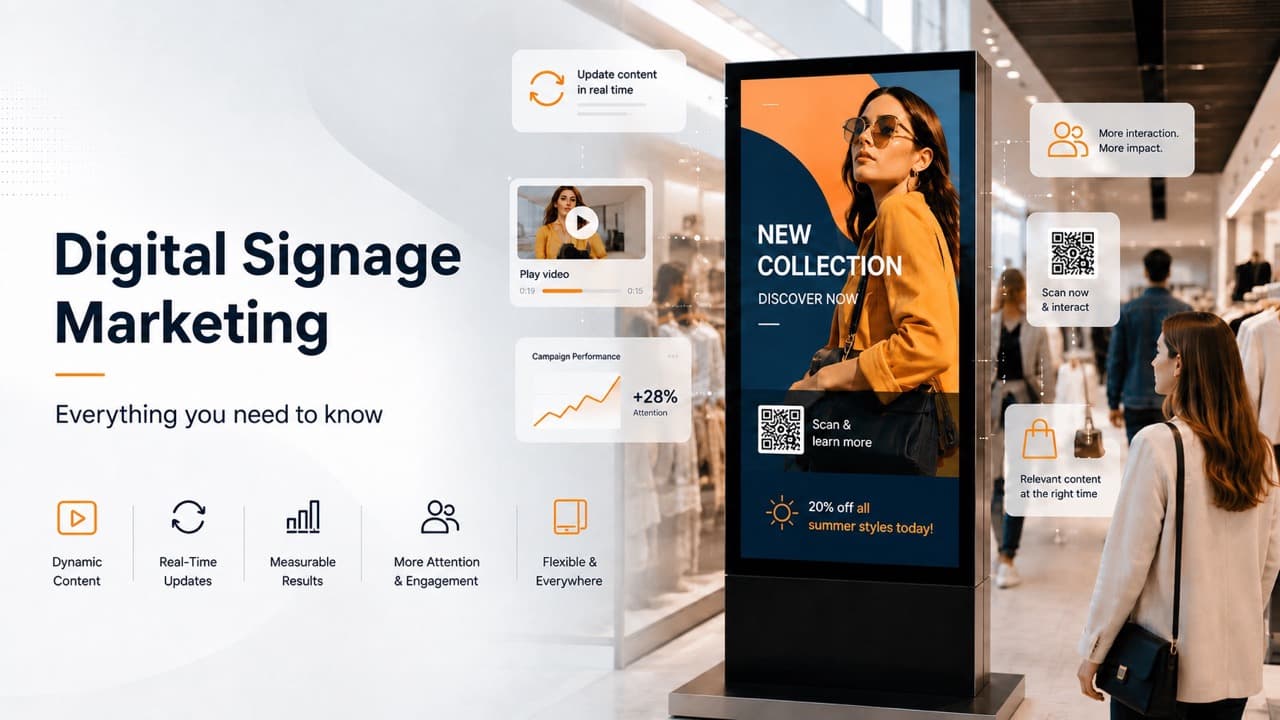
Digital signage brings marketing to the place where decisions happen: exactly where people wait, shop, compare options, or look for information. Instead of relying on static posters, companies can use digital displays to show flexible, attention-grabbing content that fits the moment.
For marketing teams, this is valuable because campaigns are no longer tied to printed material or long production cycles. Promotions, offers, service messages, and brand content can be planned centrally and updated at short notice.
Why digital signage works in marketing
People notice visual signals quickly. A bright screen with movement, a clear message, and the right timing stands out more strongly than a static sign. This is where digital signage has its advantage: content can inform, activate, and create emotion without requiring staff to explain every message.
Digital signage also fits modern customer journeys. Customers do not only meet brands online. They also meet them at the point of sale, in waiting areas, in shop windows, in restaurants, and in public spaces. Digital screens turn these physical touchpoints into controllable communication surfaces.
Motion creates attention
Motion is one of the strongest advantages of digital signage. Products can be shown in use, offers become easier to understand, and brands feel more alive. Even simple animation, rotating visuals, or short videos can make a screen stand out in a room.
The goal is not movement for its own sake. The message still needs to be understood quickly. Strong digital signage content uses short copy, clear visuals, high contrast, and one clear objective per screen.
Content stays current
Compared with printed material, digital signage is much easier to keep up to date. When prices, promotions, opening hours, or campaigns change, nothing needs to be reprinted or replaced manually. The content is updated centrally and published to the selected screens.
This makes digital signage especially useful for limited-time offers, seasonal campaigns, daily specials, or regional differences. One location can show different content from another while the marketing team keeps full control.
Relevance depends on context
Digital signage works best when the message fits the situation. In the morning, a cafe can promote breakfast offers. At lunchtime, it can highlight quick meals. In the afternoon, it can shift to coffee specials. A retailer can use entrance screens for brand storytelling and checkout screens for impulse purchases.
The context defines which message makes sense. The better content matches location, time of day, audience, and decision stage, the more likely it is to be noticed and acted on.
Common use cases
Digital signage can support many types of organizations. It is especially effective where people make decisions on site or spend time waiting.
- Retail: offers, new products, brand messages, and cross-selling at the point of sale.
- Restaurants and cafes: digital menus, daily specials, upselling, and seasonal promotions.
- Healthcare: patient information, wayfinding, waiting-room communication, and service updates.
- Education: events, room information, campus news, and internal communication.
- Fitness studios: class schedules, membership offers, motivation, community content, and partner advertising.
- Gas stations and charging parks: shop offers, services, charging information, and regional campaigns.
In every case, the screen should have a clear job. It should not simply be decorative; it should support a marketing or communication goal.
Digital signage for customer retention
Digital screens are not only useful for reaching new customers. They can also activate existing customers. Someone who is already in a store, waiting room, or checkout line is often open to relevant messages.
This is a good moment to promote loyalty programs, newsletters, social channels, coupons, or upcoming offers. QR codes can connect the screen with the customer phone and turn passive attention into a measurable follow-up action.
Service communication can strengthen loyalty as well. Messages about delivery times, product availability, consultation options, or events reduce questions and show that the business communicates clearly and stays current.
What strong digital signage content needs
The technology alone does not determine success. What matters is whether the content is easy to understand and relevant to the location. A few simple rules help teams get started:
- One message per visual.
- Short copy instead of long explanations.
- Large typography and clear contrast.
- High-quality product images or short videos.
- Regular updates instead of the same visuals for too long.
- A call to action only when a concrete action is possible.
Teams with multiple locations should also structure their content: baseline content for every location, local content for individual branches, and campaign content for defined time periods. This keeps the network scalable without making communication feel random.
Measuring performance
Digital signage becomes more valuable when campaigns are not only published but also measured. This does not require a complex setup from day one. Even simple metrics can guide better decisions.
Useful starting points include the number of active screens, played content, campaign runtimes, QR-code scans, coupon opens, and feedback from sales or service teams. Over time, these signals show patterns: which content works at which location, at what time, and for which audience?
That is how digital signage becomes more than a presentation surface. It becomes a controllable marketing channel.
Conclusion
Digital signage is a strong marketing tool when used strategically. It combines the visibility of classic in-store and out-of-home communication with the flexibility of digital campaign management.
Companies can update content faster, match messages to context more precisely, and reach customers directly on site. With clear goals, relevant content, and regular optimization, digital screens become an effective part of the marketing mix.